Biodiversity origins
Uncovering the evolutionary and earth system processes that generate biological diversity across deep time.
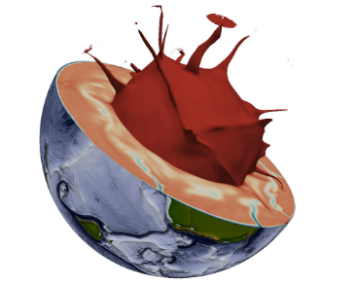
PANDORA - Co-evolution of planets and life
This project explores the interaction between Earth's physical conditions and life evolution, emphasizing the limitations of traditional approaches and the need for advanced numerical models. It aims to investigate how planetary dynamics and biological evolution co-evolve, focusing on feedback mechanisms between geodynamics, climate, surface processes, and photosynthetic life.
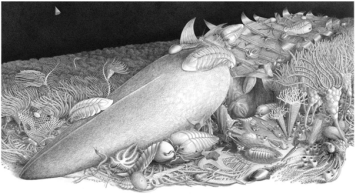
The drivers of the Cambrian explosion
We first propose to model the emergence of complex ecosystems in Earth’s oceans 500 millions years ago (i.e. the Cambrian explosion) by using bottom-up simulation of the long-term evolution of the food-web. After identifying the trigger(s) of the Cambrian explosion, we will use numerical pseudo-Earths to explore how different processes and phases of Earth’s geoclimatic dynamics lead to the diversification of living organisms.

Our project aims to create a geodynamic simulation of 4.5 billion years of an Earth-like planet's life. We want the simulation to be as detailed as possible, incorporating elemental circulation, surface processes, and climate. We then want to use this model to understand where and under what conditions life could have emerged. This more general approach will allow us to reduce the search space for possible OoL scenarios, bringing us closer to solving the mystery of life's origin.

Atmospheric Ecosystem Signatures
Addressing the lack of known Earth-like exoplanets, upcoming space missions like ESA’s PLATO aim to identify small, terrestrial targets for detailed atmospheric analysis. This project uses numerical modeling of Archean ecosystems coupled with geochemical and geophysical processes to study how biotic and abiotic feedbacks delayed the oxygenation of early Earth's atmosphere. By uncovering how biological metabolisms and planetary dynamics shape atmospheric signals like oxygen, the research informs how future missions will interpret biosignatures on habitable exoplanets.

Modelling of early prokaryote evolution and interaction with earth geodynamics
The project will couple models of prokaryotic evolution and energy metabolism with existing and newly developed geodynamic simulations of the early Earth. These simulations will explore how mantle dynamics, lithospheric rheology, surface relief, weathering, CO₂ fluxes, palaeogeography, atmosphere, and climate evolved as the Earth cooled.